Haufe X360 Reviews: What Mid-Sized Companies Really Say

August 6, 2026
Anyone searching for “Haufe reviews” or “Haufe X360 reviews” will almost inevitably end up on the relevant review sites. There, you’ll find a four- or five-star rating, a few bullet points on pros and cons, and an overall verdict based on a manageable number of reviews. For a decision that will shape a company for the next 8–15 years, that’s a flimsy foundation.
This is less a fault of the review sites than of the matter itself. Experience with an ERP system arises, to a significant extent, outside the software itself: in the way it is implemented, in the quality of the processes that result from it, and in whether employees perceive the new system as a relief or an additional burden. As a result, two companies can have completely opposite experiences with the same license, depending on who managed the project.
In this article, we’ll break down what users actually value about Haufe X360, where the criticism is justified, and why we, as an implementation partner, have made a conscious decision to rely on this system.
Haufe X360 at a Glance
Haufe X360 is a cloud-based ERP system powered by Acumatica that is designed for small and medium-sized businesses. Our ideal customer base consists of companies with between 20 and 250 employees—precisely the range where standalone solutions and legacy Excel-based systems eventually reach their limits.
A key difference from many competing cloud offerings lies in the architecture: Haufe X360 was developed from the ground up for the cloud. In day-to-day use, this is evident in automatic updates, location-independent access via a browser, and an infrastructure designed for scalability from the start.
Recommended reading: Learn more about the system in our article “What is Haufe X360?”
Positive Experiences with the Haufe X360: What Users Praise Most Often
User-Friendliness and Interface
One aspect comes up particularly often in user reviews: intuitive operation. Even more complex workflows can be mapped out without requiring months of training for the staff. This is a particularly compelling argument for small and medium-sized businesses, where few people have the time to spend weeks learning a new system while day-to-day operations continue.
The Benefits of the Cloud in Everyday Life
A direct comparison with traditional on-premises installations illustrates the concrete impact of cloud architecture:
| Dimension | Cloud ERP (Haufe X360) | On-Premise |
|---|---|---|
| Cost | Predictable annual usage fee, including operating costs | High initial investment; ongoing operating costs are added on top |
| Servers and IT | No need for your own server; no maintenance required | Own hardware; maintenance and backups are the customer’s responsibility |
| Updates | Automatic updates provided by the manufacturer | Manual, costly, and often postponed for years |
| Availability | Accessible from anywhere via a browser; work from home with no extra effort | Tied to the company network; remote access only with additional solutions |
| Scalability | Users and features scale easily | Requires new hardware and additional project effort |
Transparency and Real-Time Analytics
Because documents, orders, and transactions are all stored in the same database, there’s no need for the manual data collection work that many small and medium-sized businesses have traditionally relied on to compile their key metrics from multiple systems. Reports on revenue, contribution margin, or order backlog can be generated directly within the system and show today’s status rather than that of the last monthly closing. For management, this changes the basis on which decisions are made, because deviations become visible while there is still time to take corrective action.
Scalability for Growing Businesses
Another advantage is the multi-client capability, which is already included in the standard version. New locations or subsidiaries can be set up as separate entities, while the database remains shared and can be analyzed on a consolidated basis. Since the system also supports multiple currencies, languages, and tax regulations, new markets can be accommodated without having to implement a second system.
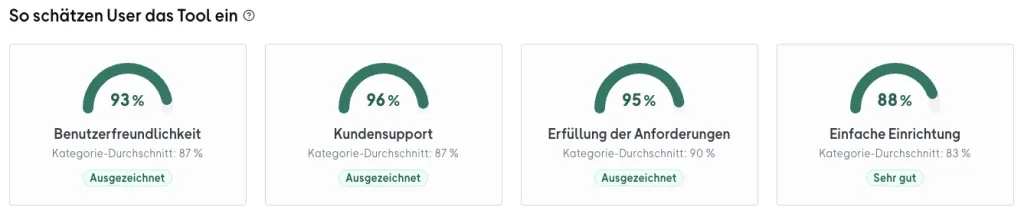
On review sites such as OMR, Haufe X360 receives above-average ratings. (Source: omr.com)
Critical Haufe X360 User Experiences: What Users Point Out
An honest review should not ignore critical voices, and two points come up repeatedly in the reviews:
Customization of individual workflows and reports: Some users describe customizing their own workflows as challenging because it requires technical expertise or external support.
AI integration: In some comments, users criticize the lack of AI features. However, Haufe is already addressing this: With Release 2026R1, AI-powered data analysis is now possible. In addition, an AI Assistant has also been announced.
What Case Studies Often Overlook: The Role of the Implementation Partner

At its core, an ERP project is an organizational and transformation initiative that just happens to involve software. Even the best system cannot solve process challenges on its own: Ultimately, it is people who work with the tools and adhere to—or fail to adhere to—workflows. That is why most ERP projects also require change management processes to help integrate the new workflows into day-to-day business operations. The rollout of a (new) ERP system requires, above all, persuasion, communication, and training from the implementation partner. Whether an ERP project ultimately turns out to be a positive or a frustrating experience is usually decided at precisely this point.
Why BOLD & EPIC Transform Relies on the Haufe X360
At this point, we want to deliberately step away from a neutral perspective and explain why we chose Haufe X360—and rejected the numerous alternatives on the market.
The decisive factor was, first and foremost, the best-of-breed approach. Closed, all-in-one suites force companies to adapt to predefined standard processes, whereas Haufe X360’s open API infrastructure allows us to specifically combine the appropriate modules, such as the existing DATEV integration as well as a web store, CRM, or time tracking. For us, this is essential to how we work, because we consistently align the architecture with our customers’ end-to-end processes—not the other way around.
Added to this is the system’s cloud-native design, which is reflected in its stability, update capabilities, and scalability. Finally, the platform’s AI capabilities impress us, because it is precisely this open architecture that makes it possible to use AI-powered automation effectively—as we do, for example, with our in-house developed email agent.
Ultimately, the system remains a means to an end for us. What matters is a tangible reduction in the workload on employees through digitalization and automation, which creates room for business growth. We view Haufe’s renewed confirmation of our Gold Partner status in 2026 as further evidence that this assessment holds true.
Conclusion: Positive experiences result from the right partnership
Overall, the user reviews of Haufe X360 paint a consistent picture: a modern, user-friendly, and highly scalable cloud ERP solution that requires a bit more attention when it comes to customization. What almost never comes up in the reviews, however, is the factor that makes all the difference: the quality of the implementation and the support provided to people during the change process.
The system, partners, and change management are all interconnected, and it is only through this synergy that the experiences our customers report are created.
Would you like to know if Haufe X360 is the right choice for your company? Schedule a no-obligation initial consultation with our team.