AI Labeling Requirements: What Companies Must Label Starting in August 2026
As of November 17, 2026. This article is not a substitute for legal advice.
Article 50 of the AI Regulation has been in effect since August 2, 2026. Anyone who publishes AI-generated images, videos, or audio content that appears authentic must disclose that it has been artificially generated or manipulated. For text, this applies when it informs the public about topics of public interest. This requirement does not apply if a human reviews the text and bears editorial responsibility. This affects any company that uses AI in marketing, sales, or communications—not just media companies. The following sections explain how different types of content should be handled.
Would you like to finally use AI efficiently in your company and establish clear rules for everyone involved? Just reach out to us! We’ll support you in your efforts.

What the AI Disclosure Requirement Covers
The transparency requirements are set forth in Article 50 of the AI Regulation. The article has seven paragraphs.
Paragraph | Who is required to comply? | What must be done? |
Par. 1 | Providers | Design systems that interact directly with people (such as chatbots) in such a way that users are aware they are speaking with an AI. This requirement does not apply if it is obvious to a reasonably informed person based on the circumstances. |
Paragraph 2 | Providers of systems that generate audio, images, video, or text | Label the output in a machine-readable format so that it is recognizable as having been artificially generated or manipulated. Exceptions include support functions for standard editing and systems that do not semantically alter the input data in any significant way. |
Paragraph 3 | Operators of systems for emotion recognition or biometric categorization | Must inform the individuals concerned about the operation of the system while complying with data protection requirements. |
Paragraph 4 | Operators | Disclose deepfakes. Label texts published to inform the public about matters of public interest as artificially generated, unless they have undergone human review by an editor with editorial responsibility. |
Paragraph 5 | Providers and Operators (for Paragraphs 1 through 4) | Provide the information clearly and unambiguously, in an accessible format, no later than the first interaction or viewing. |
Paragraph 6 | All | These obligations do not replace other requirements: The requirements for high-risk AI and other transparency obligations under EU or national law remain in effect. |
Paragraph 7 | European Commission | Promotes practical guidelines on labeling. This does not create a direct obligation for companies. |
For most companies, it depends on their role. A “provider” is anyone who develops an AI system or places it on the market under their own name—such as OpenAI or Midjourney. An “operator” is anyone who uses an AI system under their own responsibility. Anyone who uses ChatGPT, Midjourney, or an image generator to create content for their own website, newsletter, or LinkedIn profile is generally considered an operator. Paragraph 4 applies primarily to them. The machine-readable label required under Paragraph 2 is the responsibility of the tool provider. The roles are defined in Article 3.
Deadlines: The operator obligations under paragraph 4 have been in effect since August 2, 2026. The Digital Omnibus Regulation (EU) 2026/1744, in effect since July 27, 2026, established a transition period until December 2, 2026. According to several analyses, this applies to the machine-readable labeling under paragraph 2 for generative systems that were already on the market before August 2, 2026. The Frankfurt Chamber of Industry and Commerce (IHK) formulates the deadline somewhat differently and applies it to content that was placed on the market before the effective date. When in doubt, the rule is: Anyone publishing content now must include the label.
The European Commission has also published a voluntary code of conduct and guidelines. Neither is binding, but they illustrate how the authorities interpret the rules.
What Content Must Be Labeled
The decision depends on the type of content. The table summarizes what applies to day-to-day operations in small and medium-sized businesses:
Content | Should it be marked? | Basis | Example from everyday B2B practice |
Realistic image or photo, AI-generated or significantly altered | Yes, if it resembles real people, places, or events and can appear authentic | Art. 50, para. 4 | AI-generated photo of a production employee on the careers page |
Illustration, graphic, or clearly artistic depiction | Usually no, as long as nothing appears real. If in doubt, label it. | Art. 50, para. 4 | Stylized illustration in a blog post |
Video or avatar | Yes, if it appears real | Art. 50, para. 4 | AI presenter in a product video |
Voice or audio | Yes, if it appears realistic, such as with cloned voices | Art. 50, para. 4 | AI narrator in an explainer video |
Text on a topic of public interest | Yes, unless reviewed by a human with editorial responsibility | Art. 50, para. 4 | Unreviewed AI technical article published |
Chatbot in customer interactions | Yes, unless it is obvious. The responsibility lies initially with the system provider. | Art. 50, para. 1 | Chat assistant on the website |
AI-assisted proofreading, translation, and standard editing | No, if the content is hardly altered semantically | Art. 50, para. 2 | Spell check, retouching |
According to Article 3, No. 60, a deepfake is machine-generated or edited photo, audio, or video material that resembles real people, objects, places, institutions, or events so closely that a viewer might consider it authentic. The decisive factor, therefore, is the impression it makes on the viewer. An AI-generated image that simulates a scene that never actually occurred falls under this definition. A recognizably drawn illustration generally does not.
Platform features such as the AI label on Instagram are settings provided by the platform operator. They do not replace the legal obligation; in cases of doubt, the disclosure should also be included within the content itself.
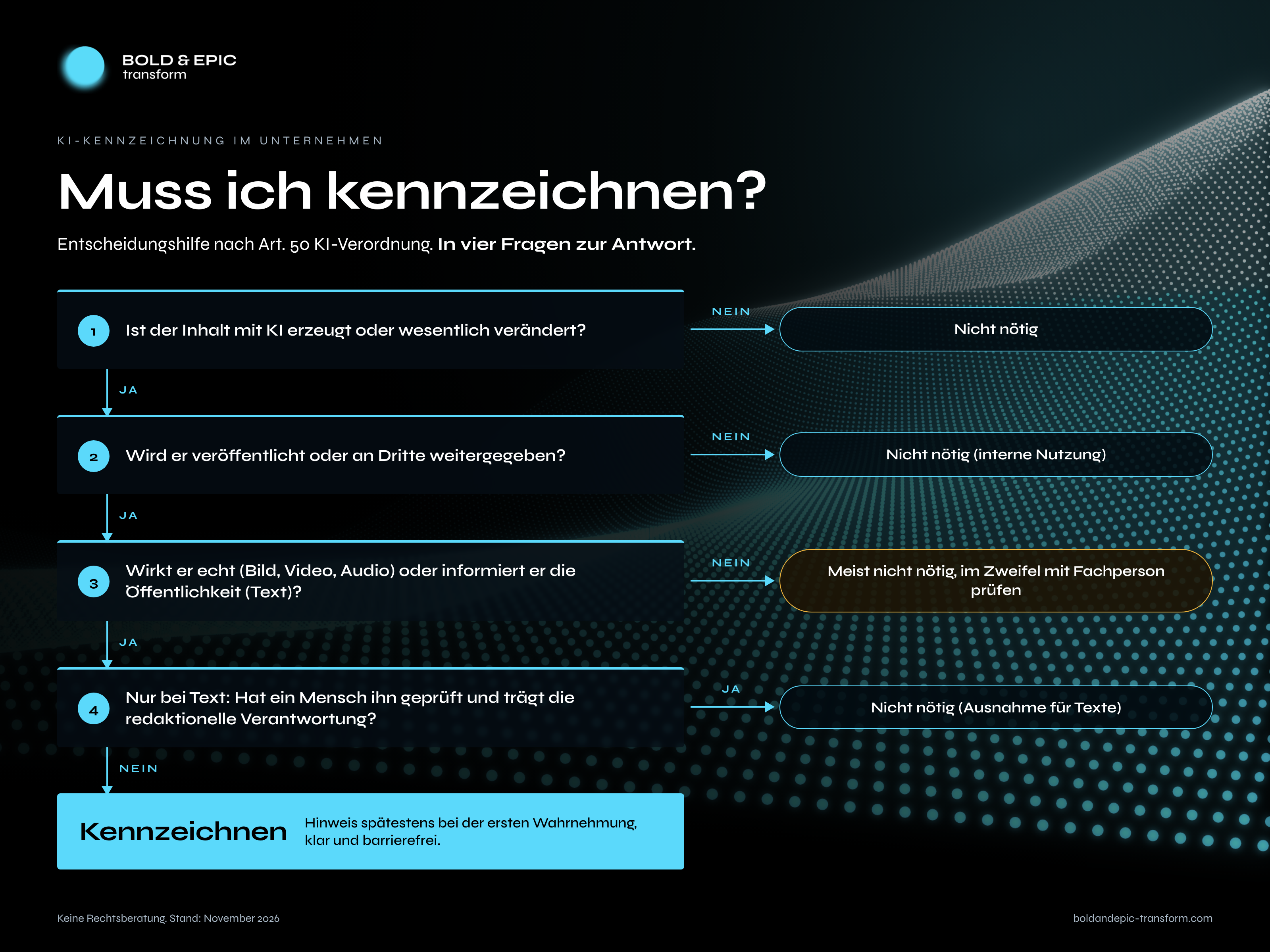
This graphic was created using AI.
When Texts Do Not Need to Be Labeled
Uncertainty is greatest when it comes to text. Paragraph 4 requires disclosure only for AI-generated text that is published to inform the public about topics of public interest. This requirement does not apply if the text has undergone human review or editorial oversight and a natural or legal person bears editorial responsibility. The European Commission confirms this on its page about the EU icons.
For day-to-day business operations, this means:
- Blog posts drafted by AI and reviewed and approved by a person: The exception applies if the review is genuine and a specific person is named as responsible.
- Fully automated text on a public topic without review: In this case, the obligation applies.
- AI-assisted spell-checking or text smoothing: Standard editing is not affected.
Whether traditional advertising and product texts even concern topics of public interest must be assessed on a case-by-case basis and has not been conclusively clarified. To be on the safe side, treat technical articles, how-to guides, and press releases as editorial content: A human reviews them, and a person takes responsibility. The effort required for this review is minimal, and the proof is valuable in the event of a dispute.
A note might then read: “This text was created with AI assistance and editorially reviewed.” While not mandatory in this case, it promotes transparency.
This is what proper labeling looks like
The law does not prescribe any specific wording. Paragraph 5 requires that the information be provided clearly and unambiguously no later than the first time it is encountered and that it meet accessibility requirements. A note included only in the legal notice or in the terms and conditions is not sufficient for this purpose, because no one sees it when viewing the content.
Phrases commonly used in practice:
- “Image created with AI”
- “AI-generated”
- “Video created with AI”
- “Artificially generated voice”
The European Commission provides three voluntary symbols: “Basic Symbol,” “Fully AI-Generated,” and “Partially AI-Modified,” each available in black and white, with and without transparency, as SVG and PNG files. Their use is optional. The symbols alone do not make content legally compliant, and responsibility remains with the operator. You should review the license terms before using them on your own website.
Format | Placement | Example |
Image | Directly on the image, not overlaid, and visible even when shared | Caption or embedded icon |
Video | Visible at startup and permanently if needed | Overlay on the first frame |
Audio | Audible cue at the beginning if visual indication is not possible | Announcement before the podcast |
Text | At the beginning of the text, under the heading | Brief note below the title |
Labeling in Marketing, Sales, and Social Media
Social Media
Posts, ads, and videos featuring realistic AI images or voices must include a disclosure within the post itself. The platform’s feature is supplementary. A disclosure that appears only in the comments or in the profile description does not fulfill the requirement because it does not appear when the content is first viewed.
Newsletters and Email
Newsletters containing AI-generated images must comply with the rules for images. AI-generated text that lacks public interest is not subject to these requirements. If you use automated AI dialogs, such as a response assistant, the chatbot guidelines in paragraph 1 apply.
Website and Product Pages
AI-generated product images that depict real products or people should be labeled, especially if they convey characteristics that a viewer might mistake for being real. Competition law also comes into play here: Anyone who withholds important information and thereby misleads market participants is acting unfairly (Section 5a of the German Unfair Competition Act (UWG)).
Chatbot
If you use a chatbot for customer contact, the very first message should make it clear to the user that they are chatting with an AI. According to paragraph 1, this obligation falls on the system provider. Check your tool to see if this notice is set as the default.
Who is responsible for auditing and documenting within the company
Labeling only works if someone is responsible for it. In most companies, the marketing department is responsible for reviewing the content, management or a designated person is responsible for approval, and the data protection officer or external experts provide guidance.

This graphic was created using AI.
Everyday Checklist:
- ☐ Is the content generated by AI or significantly altered by it?
- ☐ Is it being published or shared with third parties?
- ☐ Does it appear authentic (image, video, audio)?
- ☐ Does the text address a topic of public interest?
- ☐ Has a human reviewed the text, and is a person named as responsible?
- ☐ Is the disclosure provided no later than the first time the content is viewed?
- ☐ Is the notice accessible (size, contrast, alternative text)?
- ☐ Are the tool, date, and verifier documented?
Conclusion
The requirement is more specific than many reports suggest: Above all, realistic images, videos, and audio recordings, as well as unverified texts on public topics, must be labeled. If you have texts reviewed by a person before publication and specify who is responsible, you’re on the safe side when it comes to texts. For images, videos, and audio, a notice directly on the content—whether with the EU symbol or in words—is helpful. Clarify internally who is responsible for verification and where this is documented. You should discuss any open questions—such as those regarding the transition period—with an expert. If you’re introducing AI into your company and want to consider the rules from the start, you can find our AI consulting services on our landing page.
Frequently Asked Questions About the AI Labeling Requirement
-
This requirement applies to content that is published or made available to third parties and that could be misleading. Internal documents that do not pose a risk of misleading others are generally not affected. Establish internal standards in the AI policy.
-
Standard processing that does not involve any significant alteration of the input data is exempt under Article 50, paragraph 2. The line is drawn where the AI creates something that never existed in the first place.
-
According to several analyses, the transition period ending on December 2, 2026, applies to machine-readable labeling by providers of existing systems. The Frankfurt Chamber of Industry and Commerce (IHK) applies this to content that was made available to the public before the deadline. Sources differ on this point, so as a precaution, you should review older content that includes realistic AI-generated images or voices.
-
Purely personal use is not covered. The obligation applies as soon as content is published on behalf of the company.
-
The obligation falls on the party that publishes the content—which is generally the company acting as the operator. Agree with service providers that they will disclose their use of AI.
-
Mandatory labeling and copyright are separate issues. Only personal intellectual creations are protected by copyright. This is questionable in the case of content generated entirely by AI. If in doubt, consult a law firm specializing in this area.