AI Policy for Businesses: Legal Requirements and What Should Be Included

As of November 25, 2026. This article provides an overview and is not a substitute for legal advice.
Most of the European AI Regulation has been in effect since August 2, 2026, and since the end of July, the Federal Network Agency has been primarily responsible for oversight in Germany. For now, this has changed little in the day-to-day operations of many small and medium-sized enterprises. Employees have long been using ChatGPT, Copilot, or DeepL for quotes, emails, and translations—often without anyone having specified what data is permitted to be entered into these tools.
An AI policy closes this gap. While no law explicitly requires it, an AI policy brings together several legal requirements: the AI Regulation, the GDPR, the protection of trade secrets, and labor law. This article explains which of these apply to your company, which rules should be included in the policy, and how to implement it so that it is actually followed in day-to-day work.
Would you like to finally use AI efficiently in your company and establish clear rules for everyone involved? Just reach out to us! We’ll support you in your efforts.

Is an AI policy required?
There is no general legal requirement. Neither the AI Regulation nor the GDPR requires a document by that name. Nevertheless, companies that use AI can hardly avoid following binding rules. This starts with AI literacy. Article 4 of the AI Regulation requires operators—that is, companies that use AI systems professionally under their own responsibility—to take measures that support the development of their staff’s AI competence. The Digital Omnibus Regulation (EU) 2026/1744 has relaxed this requirement, effective July 27, 2026. Previously, a “sufficient level” of competence had to be ensured; now, appropriate measures to promote it are sufficient. This does not mean the obligation has been abolished. There is currently no specific provision for fines under Article 4, but the Federal Network Agency is responsible for oversight under the AI-MIG. At the very latest when, following an error, the question arises as to what the company has done to ensure its employees’ competence, a documented policy with a training plan will be helpful.
Added to this is the handling of data. Anyone who enters personal data into an AI tool is processing it within the meaning of the GDPR, and the company remains responsible for this. Something similar applies to trade secrets: The Trade Secrets Act protects information only if the owner has taken “appropriate confidentiality measures” (Section 2(1)(b) of the Trade Secrets Act). According to widespread interpretation, this now also includes clear rules regarding what information may be entered into external AI tools.
Finally, clear guidelines are needed to establish consequences. Through the right to issue instructions under § 106 of the German Trade Regulation Act (GewO), the employer determines how employees use their work equipment. Anyone who has never been told that customer data does not belong in a free chatbot has not violated any rule, and it would be difficult to justify issuing a written warning.
Which obligations under the AI Regulation Apply to You
The AI Regulation primarily distinguishes between providers who develop AI systems or place them on the market under their own name, and operators who use such systems. A wholesaler who uses Microsoft Copilot or an AI module in its ERP software is generally considered an operator. If, on the other hand, the wholesaler has a chatbot developed for its own website and offers it under its own brand, it can become a provider itself and assume additional obligations. The directive should define this role for every major tool, as this determines the specific obligations.
As of February 2025, certain practices will be prohibited, including AI systems designed to detect employees’ emotions in the workplace (Art. 5(1)(f)). This would include, for example, a tool that analyzes the mood of the sales team during video calls.
AI systems in human resources—such as those used for pre-screening job applications, performance evaluations, or preparing decisions on promotions and terminations—are considered high-risk (Annex III, No. 4). Under Article 26, operators of such systems must, among other things, ensure effective human oversight, maintain records, and inform employees and their representatives prior to deployment. Under the Digital Omnibus, these obligations do not take effect until December 2, 2027. However, anyone introducing a recruiting tool with AI-based ranking today should still plan for them now, as the tool will still be in use in 2027.
In addition, the transparency obligations under Article 50 have been in effect since August 2, 2026. For operators, this primarily concerns deepfakes—that is, AI-generated or altered images, videos, and audio recordings that appear authentic—as well as AI-generated texts used to inform the public about matters of public interest. We explain when your marketing content must be labeled in our article on the AI labeling requirement.
For typical work with chatbots—such as drafting, summarizing, or translating text—the AI competence requirements under Article 4 remain in effect. For this everyday use, the directive primarily specifies which tools and data are permitted.
Data Protection: What the GDPR Requires for AI Tools
An office staff member copies a customer’s complaint—including the customer’s name, account number, and order history—into ChatGPT to have it generate a friendly response. Under data protection law, this constitutes the disclosure of personal data to an external service provider, for which your company is liable. The policy should therefore answer four questions.
Is there a data processing agreement?
If an AI provider processes personal data on your behalf, you need a contract in accordance with Article 28 of the GDPR. Major providers typically only enter into such agreements for business and enterprise plans. Free consumer accounts are therefore practically out of the question for personal data, especially since user input there can be used to train the models, depending on the settings.
Where is the data processed?
If the provider is based outside the EU, the rules for transfers to third countries apply (Art. 44 et seq. GDPR). For U.S. providers, protection is usually ensured through the EU-U.S. Data Privacy Framework or through standard contractual clauses. The data protection officer should verify and document this for each tool.
Is a data protection impact assessment required?
For processing operations likely to result in a high risk, Article 35 of the GDPR requires a data protection impact assessment, and the use of new technologies is expressly listed as a criterion for this. For a writing tool that does not process any personal data, it is usually unnecessary. For a tool that analyzes job applications or employee performance data, it is very likely required.
Who makes the decision?
According to Article 22 of the GDPR, decisions that have legal effects on an individual may not be made solely by automated means. In the SCHUFA ruling of 2023, the European Court of Justice clarified that even an automatically generated score can fall under this provision if it significantly influences the subsequent decision. If the HR department uses AI to pre-screen applications, a human must therefore actually review the documents and be able to make an independent decision.
In everyday practice, a “data traffic light” system is helpful. It translates these requirements into a question that can be answered even without specialized knowledge of data protection: Which data is allowed in which tool?
Level | Data Class | Examples | Rule |
|---|---|---|---|
Green | Public Information | Published product descriptions, press releases, website content | In all approved tools |
Yellow | Internal Information | Process descriptions, internal drafts, logs without personal references | Only in tools with a business contract and verified data protection |
Red | Personal and confidential data | Customer and applicant data, cost estimates, design data, contracts | Only in tools that are explicitly approved for this level |
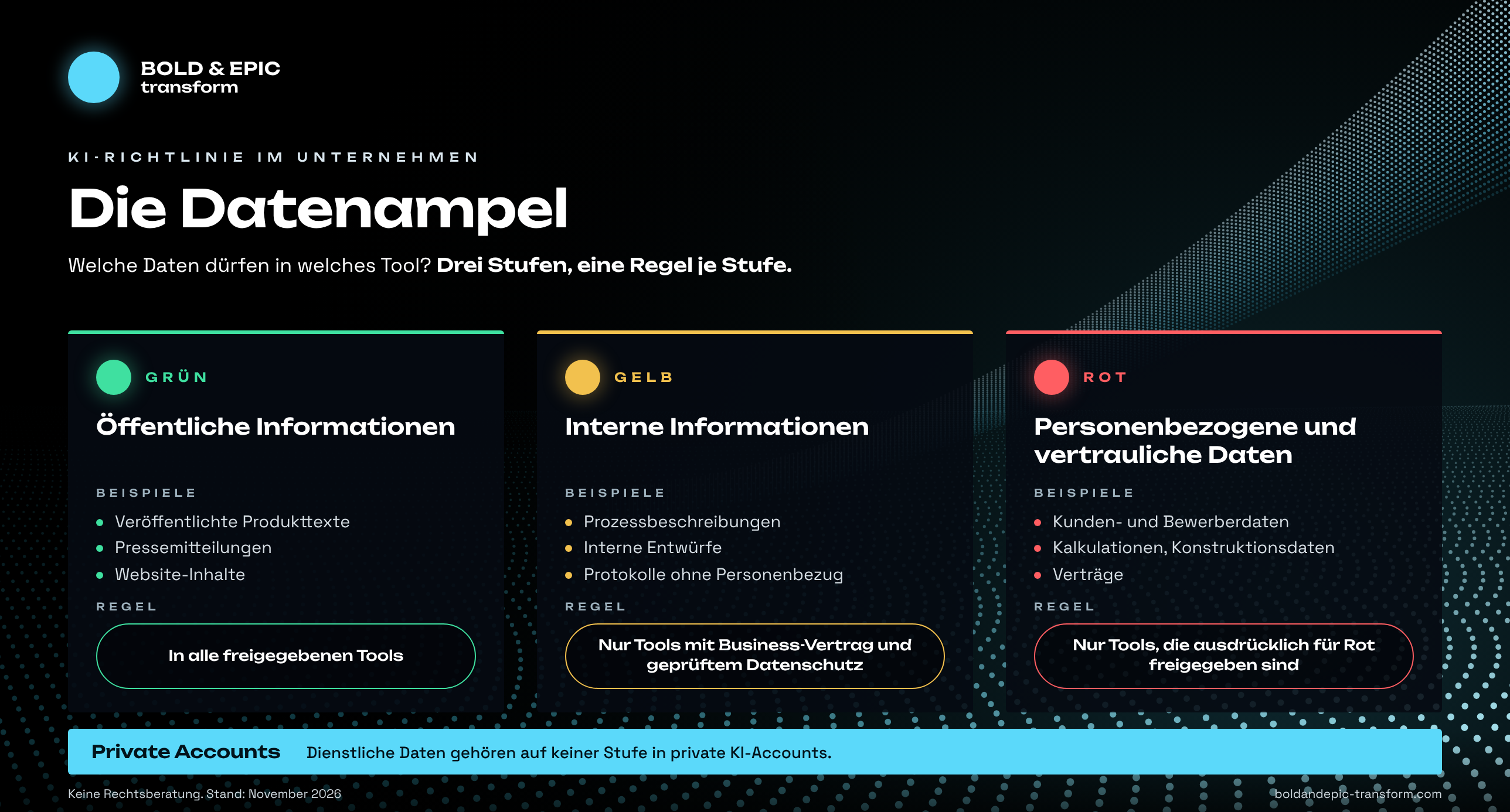
This graphic was created using AI.
The traffic light system includes a clear policy regarding personal accounts: Work-related data has no place there, because the company cannot control contracts, deletion, or access. However, this prohibition only works if you offer an approved alternative. If no such alternative is available, employees often find workarounds on their own. The company can then neither see nor control this so-called “shadow AI.”
What Should Be Included in an AI Policy
For most companies, two to four pages are sufficient. The text is generally longer only when high-risk systems are in use. In terms of content, the policy should cover the following points:
- Scope: all employees, temporary staff, freelancers, and service providers with access to company data
- Tool list: approved tools, including their purpose, classification, role under the AI Regulation, and permitted data level
- Data traffic light system and prohibition of personal accounts for business data
- Requirement to review AI results that leave the company
- Labeling of images, videos, and texts in accordance with Art. 50
- Prohibited applications, such as emotion recognition or fully automated HR decisions
- Approval process for new tools and a designated person responsible for the tool list
- Responsibilities of management, data protection, and IT
- Training prior to first use and documentation thereof
- Reporting procedure for incidents and potential consequences of violations
- Reviews at regular intervals
Sample Phrases
The following wording is intended as a guide. You should still have your own version reviewed by a legal professional.
Note: The reporting requirement is based on Article 33 of the GDPR: Depending on the circumstances, a data breach must be reported to the supervisory authority within 72 hours. This is only possible if employees report errors immediately. A policy that threatens a written warning for every mistake often has the opposite effect; therefore, you should limit sanctions to intentional or repeated violations.
"Personal data and company information classified as confidential may only be entered into AI tools that are approved in the tool list for the Red data level."
"The use of personal AI accounts for work-related tasks is prohibited. The company provides access that is suitable for work purposes."
"The person using AI-generated content intended for customers, suppliers, or the public must review it before sharing it. That person is responsible for its accuracy and legality."
“Decisions regarding hiring, promotion, transfer, or termination of employment are always made by a person. AI results serve, at most, as one of several factors in the decision-making process.”
"Anyone who discovers that personal or confidential data has been entered into an unauthorized tool must report this immediately to the data protection officer."
How to Implement a Policy
How effective the guideline is depends primarily on how it is implemented. A practical sequence of steps would look like this:

Conclusion
For most small and medium-sized enterprises, the AI Guidelines are the tool that translates the AI Regulation, data protection, trade secret protection, and labor law into rules suitable for everyday use. At its core, it requires approved tools with clear contracts and a data traffic light system that everyone can understand. Companies that also involve the works council early on and document training sessions will be well-prepared for the high-risk obligations taking effect in December 2027. Have your draft reviewed by a lawyer before it takes effect.
We’d be happy to support you with our services as you implement AI. You can find our portfolio of AI consulting services on our landing page.
Frequently Asked Questions About the AI Directive
-
Yes, as soon as they begin working with your company’s data. Article 4 of the AI Regulation explicitly covers individuals who use AI systems on behalf of the company. Specify the scope of application in the contract or in a supplemental agreement.
-
The obligations under the AI Regulation and the GDPR do not depend on the size of the company. However, for a business with 15 employees, a single page listing the tools, a data traffic light system, and a point of contact is often sufficient.
-
Legally, this is possible through the right to issue instructions. In practice, however, a total ban often leads to employees secretly working through personal accounts, which results in a loss of control for companies. A blanket ban is therefore not very practical.
-
Not simply for failing to have a policy in place. However, fines may be imposed for violations of the GDPR as well as for breaches of the prohibitions and transparency requirements of the AI Regulation, and a policy that is followed in day-to-day operations makes such violations less likely.
-
The policy is the company’s internal operating procedure. An AI statement is intended for external audiences and explains to customers or job applicants how the company uses AI. A works council agreement is concluded jointly by the employer and the works council; it is binding on both parties and often serves as the framework for the policy.
Sources
- Regulation (EU) 2024/1689 (AI Regulation), Articles 4, 5, 26, 50
- Regulation (EU) 2026/1744 (Digital Omnibus on AI), Official Journal of the EU
- AI Market Surveillance and Innovation Promotion Act (AI-MIG)
- Federal Network Agency: Press Release on the Implementation of the AI Regulation, July 29, 2026
- General Data Protection Regulation (EU) 2016/679
- Court of Justice of the European Union, Judgment of December 7, 2023, C-634/21 (SCHUFA)
- Trade Secrets Act, Section 2
- Copyright Act, § 2
- Works Constitution Act, §§ 80, 87, 90, 95
- Trade Regulation Act, § 106
- Hamburg Labor Court, Order of January 16, 2024, 24 BVGa 1/24