What Is Haufe X360? Cloud ERP for Small and Medium-Sized Businesses, Explained Simply
June 31, 2026
Haufe X360 is a cloud-based ERP solution that Haufe developed in collaboration with its technology partner Acumatica for German small and medium-sized businesses. The software has been on the market under this name since November 2021; prior to that, it was known as lexbizz Cloud-ERP. Independent tests confirm its strong market position: Both PC Magazin in June 2023 and Business & IT in February 2022 rated the system 94 out of 100 points and awarded it a “very good” rating. In 2024, GoBD compliance was also officially confirmed.
Nevertheless, it remains unclear to many prospective users what Haufe X360 actually delivers in practice, how the solution differs from SAP S/4HANA, Odoo, or Lexware Office, and what size of business it is actually intended for. This article clarifies exactly that, including the features, costs, and areas where the system reaches its limits.
Haufe X360 at a Glance
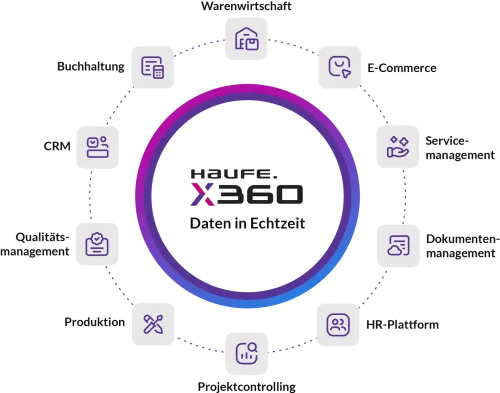
Haufe X360 is a cloud-based ERP solution designed specifically for small and medium-sized businesses. As a business management platform, it integrates key business functions—such as financial accounting, inventory management, sales, and production—into a single system. Technologically, Haufe X360 is based on Acumatica, one of the fastest-growing cloud ERP platforms worldwide, which has been adapted for the German market.
The system has a modular structure. Companies start with the core ERP functions and expand the system with additional modules and interfaces as needed. Haufe X360 runs on Microsoft Azure and is hosted in German data centers.
Origins and Development

Haufe X360 was launched in 2016, when Haufe’s sister company, Lexware, entered into a long-term partnership with Acumatica. The market launch followed in the spring of 2020, initially under the name lexbizz Cloud-ERP. It wasn’t until November 2021 that the solution was renamed Haufe X360 to position it more clearly within the Haufe portfolio.
Since then, the partner network surrounding the software has been growing steadily. The Haufe Group and Acumatica maintain a strategic partnership, which has also resulted in the German localization of the software and its adaptation to the typical requirements of small and medium-sized businesses.
Who is the Haufe X360 suitable for?
Haufe X360 is designed for small and medium-sized businesses across a variety of industries. In practice, the solution is often implemented for organizations with 50 or more users, making it more suitable for growing medium-sized businesses than for very small businesses with few employees. It is particularly widespread in retail, manufacturing, the service sector, and e-commerce.
Haufe X360 consolidates data streams from inventory management, sales, production, and accounting, thereby creating a unified database from individual siloed systems. The real added value comes from the automation of manual tasks, which saves time and minimizes sources of error.
Overview of Core Functions and Modules
Financial Accounting and Controlling
At its core, Haufe X360 covers general ledger, accounts receivable, and accounts payable, as well as automated posting workflows. It also includes multi-currency support, asset management, and a DATEV interface for collaboration with tax advisors. For internationally active medium-sized businesses, it’s also important that the system supports cross-company postings between affiliated companies and various types of exchange rates.
Merchandise Management and Logistics
The inventory management module manages item and inventory data—including batch and serial numbers—controls purchasing and automated reorders, and tracks goods receipts and order picking across multiple warehouse locations.
Sales, CRM, and E-Commerce
Customer data, quotes, and the complete service history are centrally recorded in the CRM. Through interfaces with Shopify, Shopware, and popular marketplaces, Haufe X360 can also be used for online retail, including discount and price management.
Production and Project Management
For manufacturing companies, Haufe X360 offers material requirements planning, multi-level bills of materials, and quality management—including ISO 9001 processes. Project-oriented businesses also benefit from time tracking, milestone planning, and project controlling.
Interfaces and Extensibility
Via REST and SOAP APIs, Haufe X360 can be integrated with a wide range of third-party systems, including Microsoft applications such as Teams and Power BI, HubSpot as a CRM complement, or logistics partners such as DHL. This makes the platform practical even for companies with complex IT infrastructures.
Benefits of the Haufe X360

The strengths of Haufe X360 lie in its combination of modularity, scalability, and a cloud-native architecture designed from the ground up for operation in the cloud. Companies can work from anywhere, updates run automatically in the background, and the data centers comply with local data protection requirements. The use of AI and machine learning to automate recurring tasks is now also part of the software’s feature set.
Limits and Challenges
Despite its modularity, it’s important to take an honest look at its limitations. User reviews on platforms like OMR and Capterra sometimes describe the initial setup as challenging, and the user interface is also occasionally perceived as taking some getting used to. Those who already have experience with other ERP systems generally get the hang of it faster than complete newcomers.
These challenges can be significantly mitigated with a structured implementation. A thorough analysis of the current state at the start of the project and a well-defined target concept ensure that the software aligns with actual processes from the very beginning. This is precisely where an experienced ERP consulting firm comes in.
How much does the Haufe X360 cost?
Haufe X360 is offered on a subscription basis. The price is based not only on the number of users, but also on the modules selected and the data volume. Maintenance, updates, and security patches are included in the subscription, eliminating additional costs associated with traditional IT infrastructure.
Specific prices are calculated on a case-by-case basis, as they depend heavily on the scope of each project. In practice, it is therefore advisable to schedule a non-binding initial consultation to jointly assess requirements, the number of users, and the modules before a reliable quote can be provided.
Implementing Haufe X360: What Does the Implementation Process Look Like?
A typical Haufe X360 implementation follows a multi-step process:
How well this process works depends heavily on the experience of the partner guiding you through it. The Haufe X360 services page for BOLD & EPIC Transform describes this process in detail, including the specific steps from the initial consultation to the personalized demo.
Conclusion
Haufe X360 is a modular cloud ERP built on the proven Acumatica platform and specifically tailored to the needs of midsize companies. Its strengths lie in the combination of functional depth, scalability, and a modern architecture designed from the ground up for cloud operation. As with any ERP system, however, the quality of the implementation determines whether the system’s full potential is realized.
If you want to determine whether Haufe X360 fits your processes, you shouldn’t base your decision solely on a list of features. A personal consultation with an experienced partner usually provides clarity much more quickly. Schedule a no-obligation initial consultation with BOLD & EPIC Transform and find out whether Haufe X360 is the right solution for your company.
FAQ – Questions That Are Often Overlooked in ERP Comparisons
-
There is a notice period of about three months. After the contract ends, customers will first receive their complete data so that statutory retention periods can be observed before the data is deleted by the provider. Since terms and conditions may vary depending on the contract, it’s worth reviewing your own contract or asking about them during your initial consultation.
-
No. The official Haufe X360 pricing page explicitly states that neither a free trial nor an online demo is offered. Instead, the initial contact takes the form of a free, no-obligation consultation to assess your needs, followed by a customized demo.
-
Very mixed. User reviews on platforms such as Capterra range from accounts of a smooth, professionally guided implementation to reports in which promised features were not implemented as agreed and the project support provided by the recommended partner company is described as inadequate. In practical terms, this means that when selecting a provider, the implementation partner’s experience deserves at least as much attention as the software’s feature set itself.
-
Not always. Simpler adjustments—such as those to dashboards or filter settings—can be made even without prior knowledge.
-
Yes. Haufe X360 supports multiple languages, various exchange rate types with automatic conversion, and consolidated cross-company transactions between affiliated companies. For medium-sized companies with foreign subsidiaries or multiple legally independent entities, this is a key feature that rarely appears in general product descriptions.
-
According to an independent assessment on the comparison portal erp-software.org, the solution is frequently used in practice by organizations with 50 or more users. Licensing is not exclusively based on a traditional named-user model, but is partly usage- and resource-based, depending on the modules purchased and data volume. For your own budget planning, this detail is often more informative than simply classifying the product as SaaS.